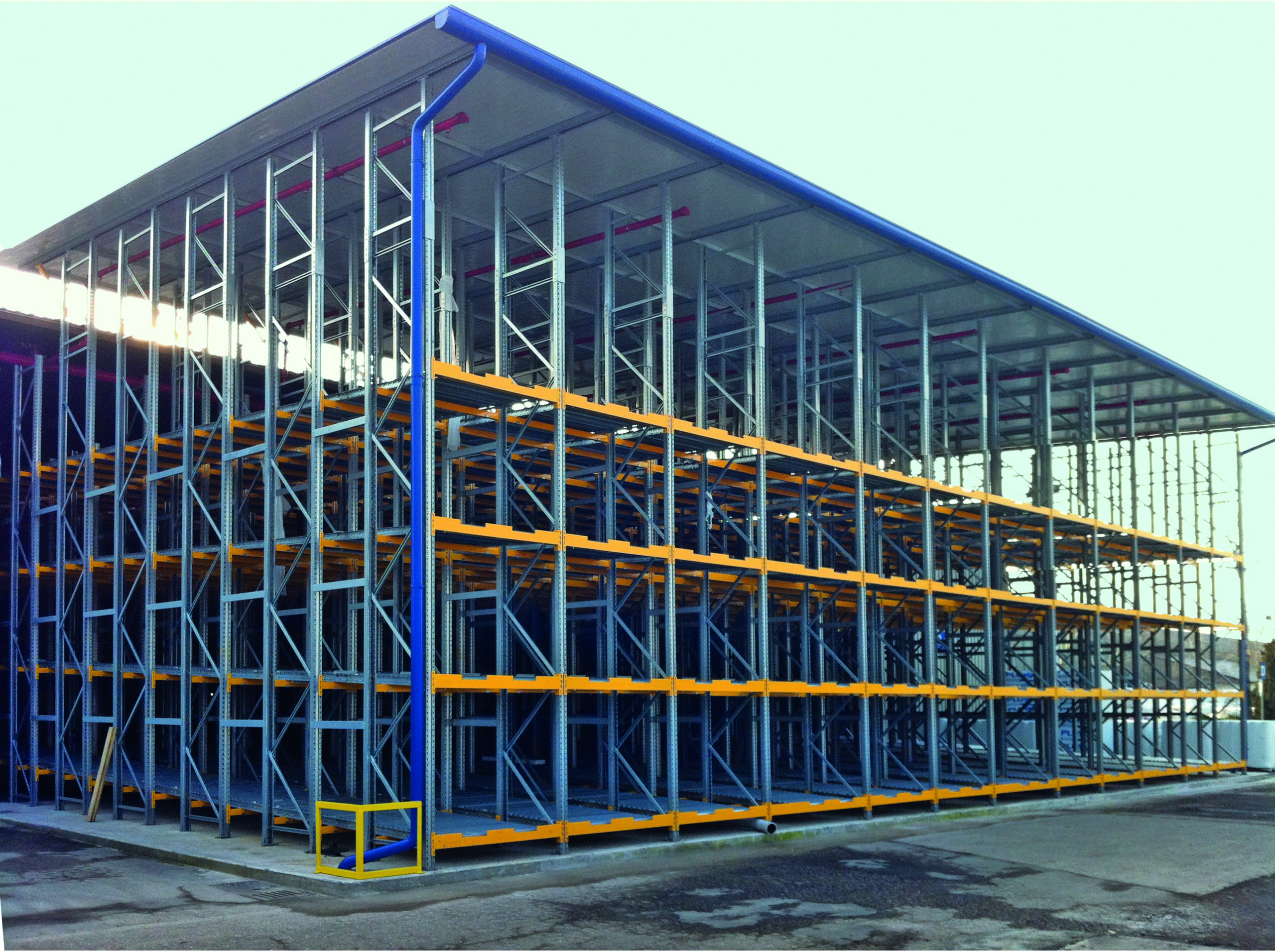

Dynamic warehouse: what it is, how it works, and when it’s truly worth it
In these situations, a dynamic warehouse is one of the most efficient storage solutions for managing large quantities of fast-moving goods, improving operational workflows and maximizing space utilization.
- What is meant by a dynamic warehouse?
- How a roller-based dynamic warehouse works: the gravity principle
- Types of dynamic warehouse
- Advantages of a dynamic warehouse
- In which applications is a dynamic warehouse used?
- When is it worth choosing a dynamic warehouse?
- The most common mistakes
- How to design a dynamic warehouse: key parameters to evaluate
- Frequently asked questions
- Conclusion
The principle behind it is simple: using gravity to automatically move pallets or containers within the racking system through inclined lanes that connect the loading point to the picking point. This allows goods to advance in a controlled manner without the need for continuous manual handling.
However, there is no single configuration. Depending on operational requirements, a dynamic warehouse can operate using FIFO or LIFO principles, support picking activities, or integrate with automated systems such as pallet shuttles.
In this article, we will explore:
- what a dynamic warehouse is;
- how it works;
- the different types available;
- when it is worth implementing;
- the mistakes to avoid during the design phase.
What is meant by a dynamic warehouse?
A dynamic warehouse is an intensive storage system in which loads move through inclined lanes by means of gravity, without the need for continuous mechanical handling systems.
Unlike a traditional static warehouse, where each pallet is manually stored and retrieved from the same aisle, in a dynamic warehouse:
- loading and picking take place on separate sides;
- pallets move forward automatically;
- internal aisles within the lanes are eliminated;
- storage density is increased.
This approach makes it possible to maximize the use of available space and speed up operational flows, particularly in environments with a high inventory turnover rate.
From a technical standpoint, the core of the system consists of roller tracks: a series of rollers installed along the lanes that allow pallets to move in a controlled manner toward the picking face.
How a roller-based dynamic warehouse works: the gravity principle
The role of the incline
The operation of a dynamic warehouse is based on a slight incline of the racking system, typically around 4% for pallets. This slope allows loads to move automatically along the lane by means of gravity.
However, the incline must be carefully calibrated according to:
- pallet weight;
- load unit dimensions;
- type of goods;
- desired travel speed.
An incorrect design could negatively affect the system’s flow efficiency, safety, and stability.
The pallet’s journey: from loading to picking
The operational flow is simple and continuous:
- the pallet is placed at the entrance of the lane;
- the load moves along the rollers;
- it gradually reaches the picking face;
- when the first pallet is retrieved, the following pallets automatically move forward.
This mechanism reduces handling times and ensures that goods are always available in the correct position.
Safety components
To ensure controlled operation, the system incorporates several safety devices:
- brake rollers, which regulate the speed of movement;
- pallet centering devices, which keep the load aligned during travel;
- end stops, which secure the pallet in the correct picking position.
These components help protect both goods and operators by reducing the risk of impacts or uncontrolled movements.
Types of dynamic warehouse
There is no single dynamic warehouse configuration. The most suitable solution depends on factors such as inventory turnover, number of SKUs, FIFO or LIFO management logic, and the available space.
FIFO gravity racking systems
In FIFO (First In, First Out) gravity racking systems, loading takes place on one side and picking on the opposite side. As a result, the first pallet loaded is also the first pallet retrieved.
This configuration is particularly suitable for:
- products with expiration dates;
- the food and pharmaceutical industries;
- high-turnover SKUs;
- environments where traceability is mandatory.
In these cases, solutions such as gravity-fed racking systems allow automatic stock rotation without the need for additional manual intervention.
Push-back LIFO racking systems
In a push-back system, loading and picking take place from the same side according to a LIFO (Last In, First Out) principle.
Each new pallet pushes the pallets already stored further back into the lane, optimizing the use of available space.
This solution is particularly suitable for:
- non-perishable products;
- large quantities of the same SKU;
- warehouses with a single operating face.
Dynamic picking racking systems
Dynamic racking systems can also be used for bins, containers, and packages intended for manual picking.
In this case:
- the operator always picks from the front side;
- replenishment takes place automatically from the rear;
- travel distances and order preparation times are reduced.
They are widely used in kanban systems and high-frequency picking areas.
Mobile dynamic warehouse
This configuration combines dynamic racking systems with mobile bases mounted on rails, further increasing storage density.
The system is particularly suitable when:
- available space is limited;
- SKUs have a low access frequency;
- storage capacity needs to be maximized without expanding the warehouse.
Solutions such as mobile pallet racking systems make it possible to store a large number of pallets within a limited footprint.
Automated dynamic warehouse (pallet shuttle)
The pallet shuttle represents an evolution of the traditional dynamic warehouse. In this case, a motorized shuttle automatically moves pallets within the storage lanes.
The system:
- eliminates the need for forklift entry into the lanes;
- increases speed and safety;
- supports both FIFO and LIFO management principles;
- is ideal for cold storage facilities and high-volume operations.
In high-intensity operational environments, systems such as the pallet shuttle racking make it possible to increase storage density and productivity while reducing vehicle travel distances.
Advantages of a dynamic warehouse
Compared to traditional racking systems, a dynamic warehouse offers tangible advantages in terms of both space utilization and operational efficiency.
Space optimization
Eliminating internal aisles within storage lanes makes it possible to maximize the use of available space. In some cases, storage capacity can increase by up to 70% compared to a traditional pallet racking system.
This advantage is particularly evident in warehouses with limited floor space or high costs per square meter, where recovering storage space without expanding the facility becomes a strategic priority. In addition, concentrating more pallets within the same area helps create more compact and organized material flows.
Reduction of travel distances
Operators do not need to enter the storage lanes to place or retrieve goods. This reduces:
- handling times;
- equipment operating hours;
- forklift wear and tear;
- energy consumption.
Automatic stock rotation
In FIFO systems, pallets automatically move toward the picking face. This prevents older stock from remaining stored in the lanes, reducing waste and the risk of product expiration.
Stock rotation takes place naturally and continuously, without the need for manual checks or rehandling by operators. This aspect is particularly important in industries where traceability and expiration date management directly affect service quality and regulatory compliance.
Operator safety
Reducing forklift access inside the racking system means lowering the risk of impacts and collisions. In addition, more organized traffic routes and controlled material handling improve operating conditions in compliance with Legislative Decree 81/2008.
The number of maneuvers is also significantly reduced, with a positive impact on both safety and the wear and tear of handling equipment. In high-intensity operating environments, this helps create a warehouse that is more stable, efficient, and easier to manage.
In which applications is a dynamic warehouse used?
Dynamic warehouses are primarily used in environments where speed, storage density, and continuous material flow are key requirements.
High-turnover SKUs in large volumes
When the same product is handled frequently and in large volumes, assigning a dedicated lane to each SKU helps speed up loading and picking operations.
In these environments, a dynamic warehouse reduces waiting times and makes operators’ work more efficient, especially during peak activity periods. The continuous availability of goods at the picking face also helps maintain high productivity levels, even under very intensive operating conditions.
Perishable products and batch management
In the food, pharmaceutical, and cosmetics industries, automatic FIFO management helps ensure proper control of:
- expiration dates;
- batches;
- product traceability.
Buffers between production departments
Dynamic warehouses are often used as buffer areas between production and shipping, ensuring operational continuity and absorbing workload peaks.
This function is particularly useful in manufacturing environments where different departments operate at different speeds. A dynamic system helps prevent sudden build-ups or bottlenecks, maintaining a steady flow of goods from one stage to the next.
Cold storage facilities
In temperature-controlled storage facilities, reducing internal movements helps limit door openings, energy consumption, and the time operators spend in cold environments.
In addition, increasing storage density makes it possible to maximize the use of every available cubic meter, a crucial factor in environments where energy and operating costs are particularly high. For this reason, dynamic and shuttle systems are widely used in cold chain logistics.
When is it worth choosing a dynamic warehouse?
A dynamic warehouse is particularly effective when:
- there are at least 3 to 5 pallets per SKU;
- FIFO rotation is required;
- available floor space is limited;
- handling volumes are high;
- products have expiration dates or high turnover rates.
The most common mistakes
Understimating the number of pallets per SKU
If SKU volumes are too low, the dynamic lane may be underutilized, reducing the benefits of the system.
In practice, dedicated storage space is occupied without delivering a real advantage in terms of density or operational speed. Before designing the layout, it is therefore important to carefully analyze volumes, turnover rates, and the average number of pallets per SKU.
Failing to verify pallet compatibility with roller tracks
Damaged or non-standardized pallets can compromise the proper flow of goods.
Even minor dimensional differences or deformations in the pallet base can cause blockages, irregular movement, or excessive wear on the roller tracks. For this reason, the quality and consistency of load units are fundamental considerations when designing the system.
Neglecting maintenance
Rollers, brake rollers, and safety components must be inspected regularly to ensure operational continuity.
Over time, wear, dust, or accidental impacts can affect the proper functioning of the system. Preventive maintenance helps avoid unexpected downtime, reduces the risk of damage, and extends the service life of the installation.
Choosing LIFO when FIFO is required
In some industries, such as food and pharmaceuticals, proper stock rotation is not an option but a regulatory requirement.
In most cases, these issues result from inadequate system design or an incomplete assessment of actual operational flows.
How to design a dynamic warehouse: key parameters to evaluate
Designing a dynamic warehouse requires an in-depth analysis of the warehouse’s operational characteristics.
The main parameters to evaluate include:
- type and weight of pallets;
- number of SKUs;
- pallets per SKU;
- FIFO or LIFO management logic;
- lane depth;
- available height;
- handling frequency;
- integration with existing WMS and logistics processes.
At this stage, the layout becomes critical: incorrect lane sizing, improper inclines, or choosing the wrong configuration can compromise both the efficiency and safety of the entire system.
For this reason, it is important to rely on a specialized partner capable of:
- carrying out technical site inspections;
- simulating operational flows;
- designing the layout;
- properly sizing the structures.
Armes supports companies in the design of integrated dynamic storage systems, developing solutions tailored to available space, storage volumes, and operational objectives. For more information, you can contact the team using the form available in the website footer.
Frequently asked questions
What is the difference between a dynamic warehouse and a static warehouse?
In a static warehouse, each pallet is handled manually, and aisles occupy a significant portion of the available space. In a dynamic warehouse, on the other hand, pallets move automatically within storage lanes, increasing both storage density and operational efficiency.
Does it also work in cold storage facilities?
Yes. In fact, in cold storage environments, a dynamic warehouse helps reduce travel distances and operators’ time spent in refrigerated areas, while also minimizing thermal dispersion.
What maintenance does it require?
It is important to regularly inspect:
- roller tracks;
- brake rollers;
- safety stops;
- the overall condition of the storage lanes.
To ensure operational continuity, it is advisable to implement an annual preventive maintenance plan.
Conclusion
A dynamic warehouse is an effective solution for increasing storage density, accelerating material flows, and improving stock rotation, especially in high-throughput environments.
However, achieving tangible results requires more than simply selecting a racking system. It is essential to properly design the layout, storage lanes, operating logic, and integration with warehouse workflows.
In this context, Armes supports companies in designing tailored dynamic storage systems, combining operational efficiency, safety, and optimized space utilization.


 Redazione
Dynamic warehouse: what it is, how it works, and when it’s truly worth it
READ THE ARTICLE Redazione
Automated storage: what it is, how it works and when it really pays off
READ THE ARTICLE